
Sports · 5 min read · By Vignesh Manikandan
Published
The Tech Behind FIFA World Cup 2026: AI, VAR, Smart Balls & More
From AI powered officiating and smart footballs to advanced player tracking and real-time analytics, FIFA World Cup 2026 is showcasing the future of football technology. Explore the innovations transforming how the game is played, analyzed, and experienced around the world.
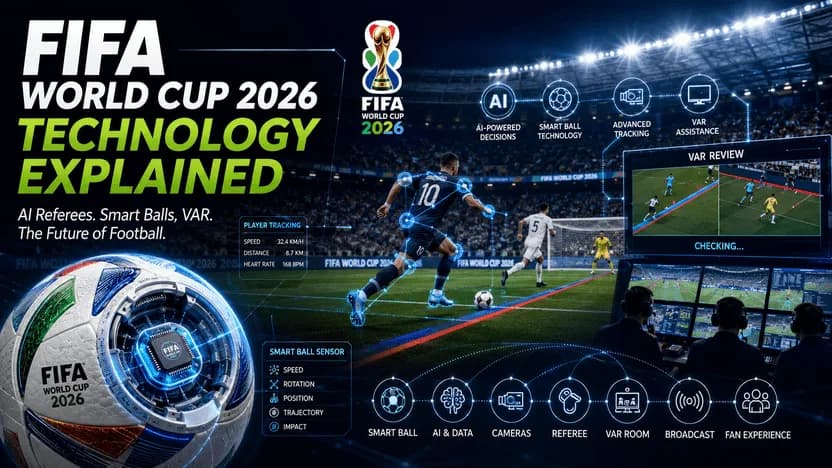
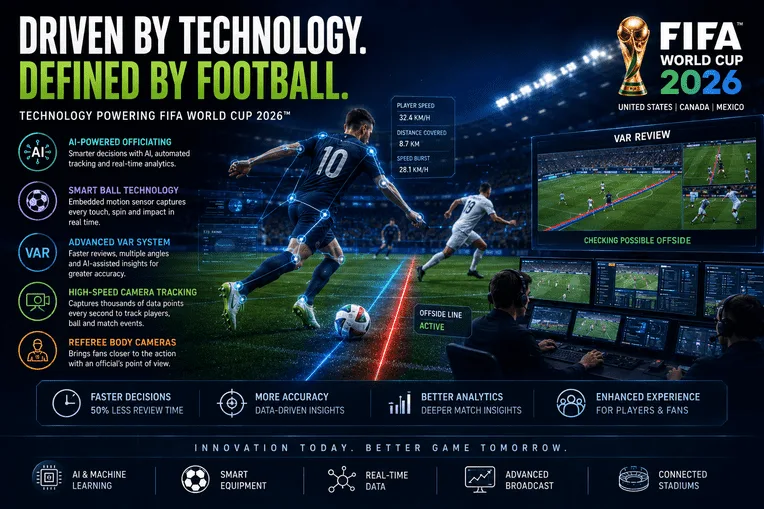
In short: FIFA World Cup 2026 uses semi-automated offside technology, a smart match ball with a motion sensor, AI-powered VAR, 3D player tracking, high-speed camera tracking, referee body cameras and real-time analytics to make decisions faster and more accurate.
Introduction
The FIFA World Cup 2026 is not only the biggest World Cup in history, featuring 48 teams, 104 matches, and three host nations.
It is also one of the most technologically advanced sporting events ever organized.
From AI powered officiating systems to smart footballs and real-time player tracking, technology is playing a bigger role than ever before.
The goal is simple:
- Improve decision making
- Reduce human error
- Enhance the fan experience
- Improve match analysis
- Make football fairer and faster
In this blog, we explore the key technologies being used in FIFA World Cup 2026 and how they are shaping the future of football.
1. Semi Automated Offside Technology (SAOT)
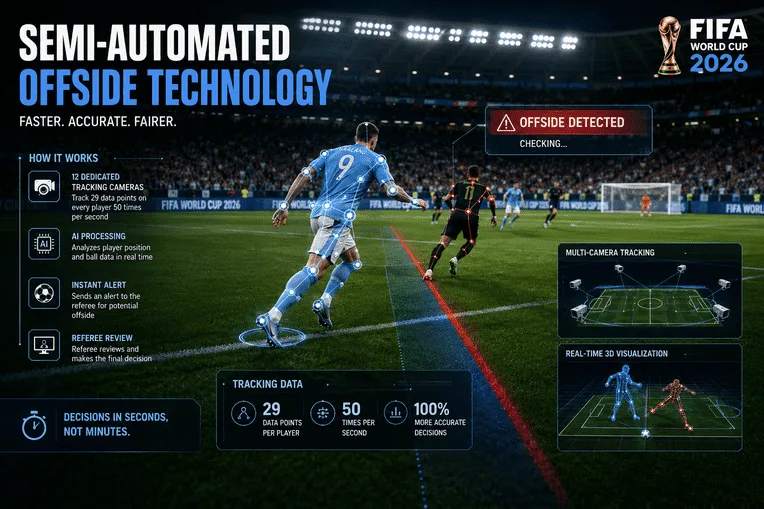
One of the biggest technological advancements in FIFA World Cup 2026 is the upgraded Semi Automated Offside Technology (SAOT).
The system combines:
- High speed tracking cameras
- Artificial intelligence
- Smart ball data
- Real time player tracking
The technology continuously monitors player positions and automatically alerts match officials when a potential offside situation occurs.
Why It Matters
- Faster decisions
- Greater accuracy
- Reduced human error
- Improved transparency for fans
Offside decisions that once required lengthy reviews can now be processed significantly faster while maintaining high accuracy.
2. The Smart Match Ball
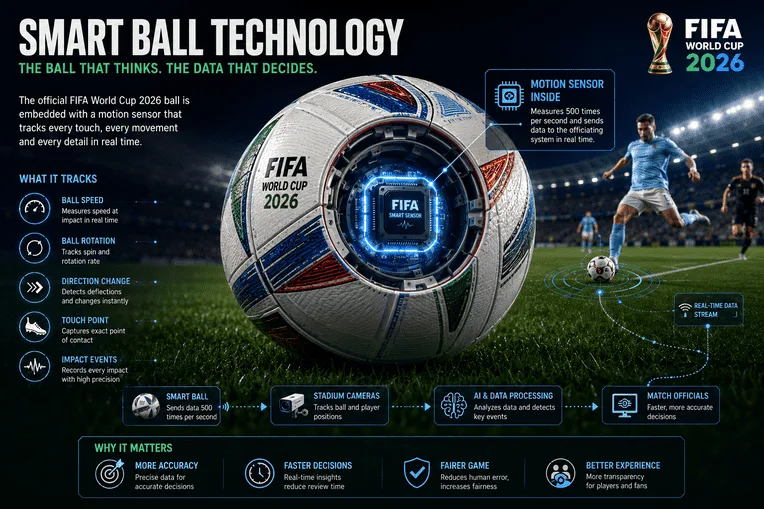
The official FIFA World Cup 2026 match ball is one of the most advanced footballs ever created.
Inside the ball is a motion sensor capable of tracking movement hundreds of times per second.
What the Smart Ball Tracks
- Ball speed
- Ball rotation
- Direction changes
- Exact touch points
- Impact events
The sensor continuously sends data to the officiating system, helping referees make more accurate decisions.
Why It Matters
The smart ball improves:
- Offside detection
- Handball reviews
- Deflection analysis
- VAR decision-making
For the first time, the football itself has become an active part of the technology ecosystem.
3. AI Powered VAR
Video Assistant Referee (VAR) continues to evolve.
At FIFA World Cup 2026, artificial intelligence plays a larger role in supporting match officials.
AI helps process:
- Player tracking data
- Ball tracking data
- Match events
- Potential incidents
The system helps identify situations that require review and provides faster access to relevant information.
Important Note
AI assists referees.
It does not replace them.
The final decision always remains with the match officials.
4. 3D Player Tracking and Digital Models
Modern football generates enormous amounts of player data.
To improve officiating and broadcasting, FIFA uses advanced tracking systems to create digital player models.
Benefits
- Better offside visualization
- Improved replay accuracy
- More detailed match analysis
- Enhanced TV graphics
This technology helps explain decisions more clearly to fans watching around the world.
5. High Speed Camera Tracking Systems
Every FIFA World Cup 2026 stadium is equipped with advanced camera systems that continuously track player movement.
These cameras capture thousands of data points during every match.
Data Collected
- Position
- Speed
- Distance covered
- Acceleration
- Tactical movement
This information is used by:
- Referees
- Broadcasters
- Analysts
- Teams
to better understand what happens on the field.
6. Referee Body Cameras
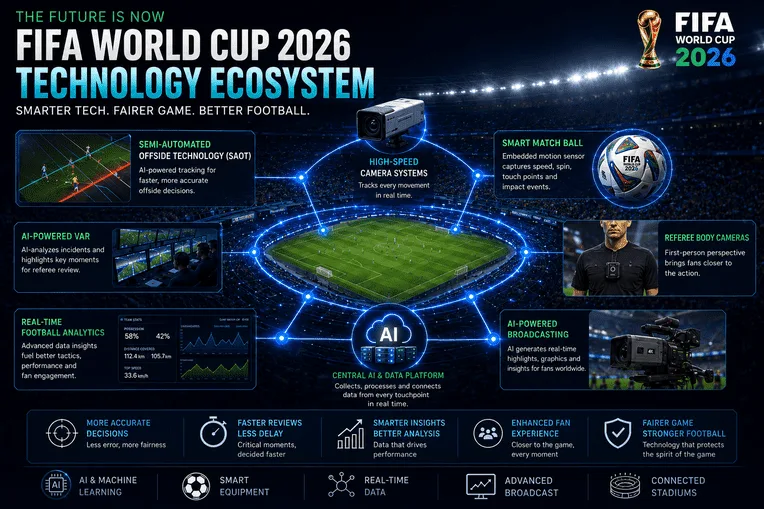
One of the most exciting additions to FIFA World Cup 2026 is the use of referee body cameras.
These cameras provide a first person perspective of the game.
Why Fans Love It
Body cameras provide:
- Unique viewing angles
- Better understanding of referee decisions
- Enhanced broadcast experiences
For many fans, it is the closest experience to being on the pitch during a World Cup match.
7. AI Powered Broadcasting
Broadcasting a tournament with 104 matches across three countries requires massive technological infrastructure.
To support this scale, FIFA is deploying AI-powered broadcasting systems that improve content delivery and viewer engagement.
Key Benefits
- Faster content delivery
- Automated highlights
- Real time match analytics
- Improved global coverage
This allows fans worldwide to consume content more quickly and efficiently.
8. Real Time Football Analytics
Modern football is becoming increasingly data-driven.
Every World Cup match generates millions of data points.
These analytics help:
- Coaches make tactical decisions
- Broadcasters provide deeper insights
- Fans understand the game better
- Teams improve performance
Football is no longer analyzed only through what we see.
It is increasingly analyzed through data.
How Technology Is Changing Football
The FIFA World Cup 2026 demonstrates how technology can improve football without changing the essence of the game.
More Accurate Decisions
Technology reduces officiating errors and improves fairness.
Better Fan Experience
New camera angles, graphics, and real time insights bring fans closer to the action.
Faster Match Reviews
AI and automation reduce delays during critical decisions.
Smarter Analysis
Teams now have access to more information than ever before.
The Future of Football Technology
The technologies used in FIFA World Cup 2026 are likely to become standard across football over the next decade.
We can expect:
- More advanced AI officiating
- Smarter sports equipment
- Better player tracking
- Enhanced fan experiences
- More data driven coaching
Football is becoming smarter, faster, and more connected.
And FIFA World Cup 2026 gives us a glimpse into that future.
What this means for football in India
Technology like this starts at the top, but most players in India still learn the game on a local turf or school ground. A well-built pitch with the right base, drainage and turf is the first step. See how we build football turfs across India.
Final Thoughts
FIFA World Cup 2026 is not just the biggest football tournament ever organized.
It is also a showcase of how technology is transforming the world's most popular sport.
From AI powered officiating and smart footballs to advanced player tracking systems and real time analytics, these innovations are helping make football more accurate, engaging, and exciting than ever before.
As technology continues to evolve, many of these innovations will shape the future of football at every level of the game.
Key Technologies Used in FIFA World Cup 2026
Semi Automated Offside Technology (SAOT)
Smart Match Ball Technology
AI Powered VAR
3D Player Tracking
High Speed Camera Systems
Referee Body Cameras
AI-Powered Broadcasting
Real Time Football Analytics
Follow Fitoverse
Interested in sports technology, sports infrastructure, and the future of sports innovation?
Follow Fitoverse as we continue exploring the technologies, ideas, and innovations shaping the future of sports around the world.
Stay connected for more insights, industry stories, and deep dives into the trends transforming sports globally.