
Sports · 3 min read · By Vignesh Manikandan
Published
FIBA Basketball Court Dimensions: Full Court, 3x3 Size & Runway Guide
Planning a basketball court involves more than just marking the playing area. This guide explains official FIBA dimensions, 3x3 court sizes, runway requirements, and the key design elements that impact safety and gameplay.
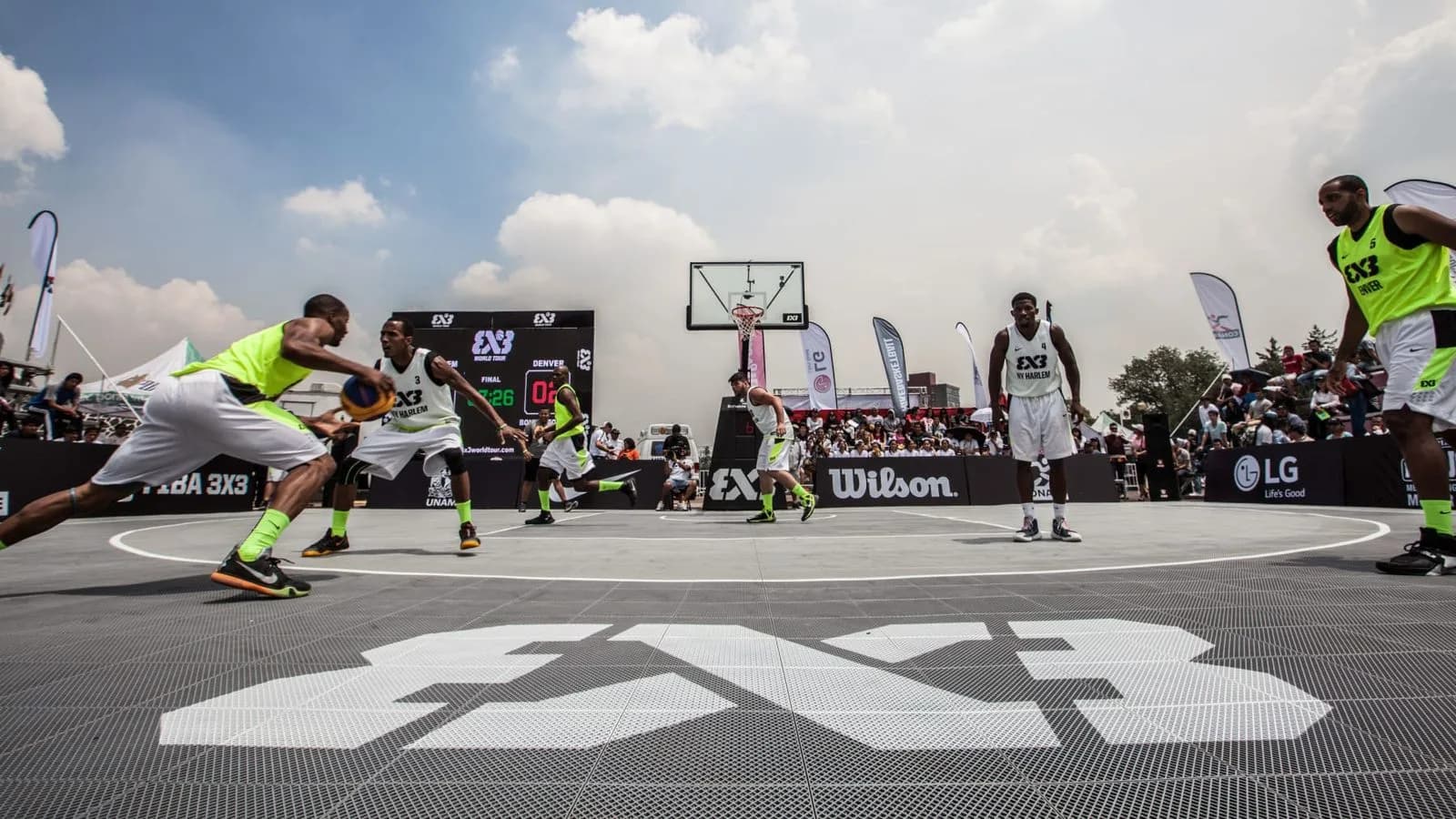
In short: A FIBA full basketball court is 28 × 15 m (92 × 49 ft) and needs at least 2 m of clear runway on every side, so plan 32 × 19 m in total. A FIBA 3x3 court is 15 × 11 m, or 19 × 15 m with its runway.
| Court | Playing area | With 2 m runway |
|---|---|---|
| FIBA full court | 28 × 15 m (92 × 49 ft) | 32 × 19 m |
| FIBA 3x3 court | 15 × 11 m | 19 × 15 m |
Introduction
When designing a basketball court, most people focus only on the playing area.
But in reality, a proper basketball facility includes more than just the court. It involves the playing area, the non-playing area (runway), and supporting spaces for teams, officials, and audience.
In India, most basketball courts follow FIBA standards. These standards define both the playing dimensions and the minimum safety clearances required around the court.
In this blog, we will cover the official FIBA dimensions, 3x3 court sizes, and why proper design plays a huge role in basketball court construction.
FIBA Basketball Court Dimensions (Full Court)
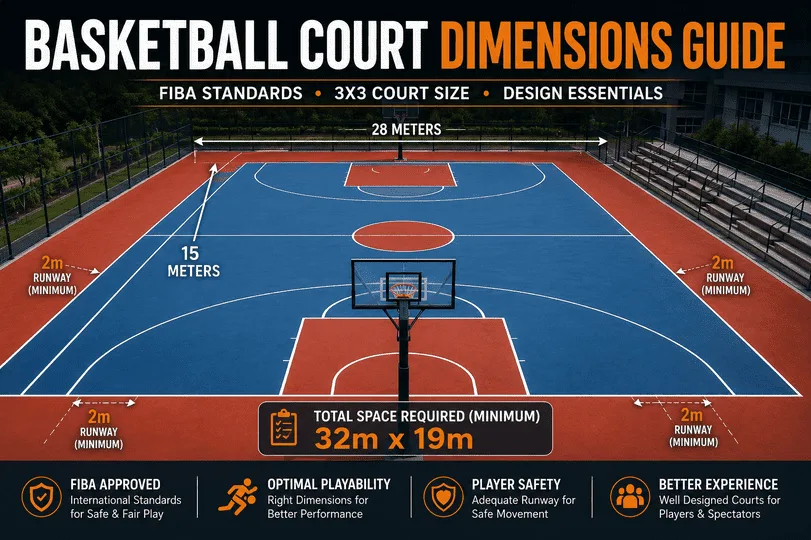
As per FIBA, the standard dimensions for a full basketball court are:
Playing Area
- Length: 28 meters
- Width: 15 meters
These dimensions are followed in:
- international competitions
- professional courts
- most schools and colleges in India
FIBA Non-Playing Area (Runway / Safety Zone)
FIBA also defines the minimum clear space required around the court.
Requirement
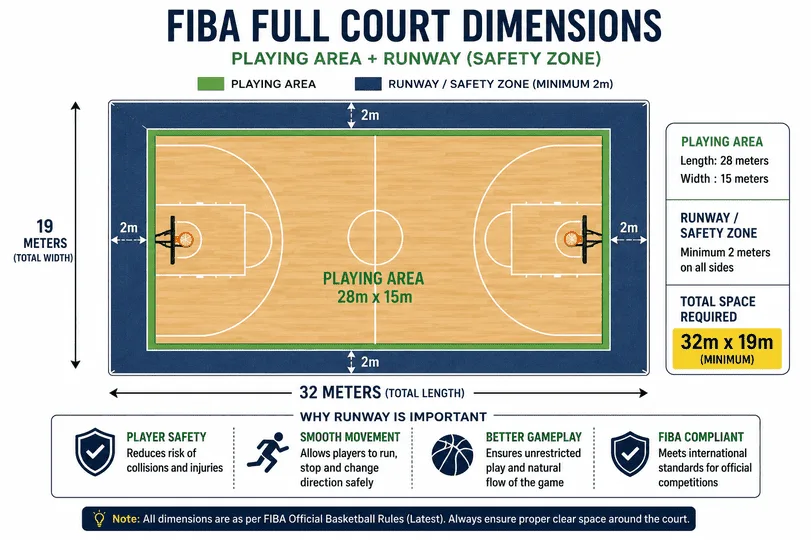
- Minimum 2 meters of clear space on all sides
This space is known as the runway or safety zone.
It is essential for:
- player safety
- smooth movement during gameplay
- avoiding collisions with surrounding structures
Total Space Required (Minimum as per FIBA)
When we include the runway:
- Length: 28m + 2m + 2m = 32 meters
- Width: 15m + 2m + 2m = 19 meters
So, the minimum total area required is:
32m × 19m
FIBA 3x3 Basketball Court Dimensions
3x3 basketball is one of the fastest growing formats and is also part of the Olympics.
Playing Area
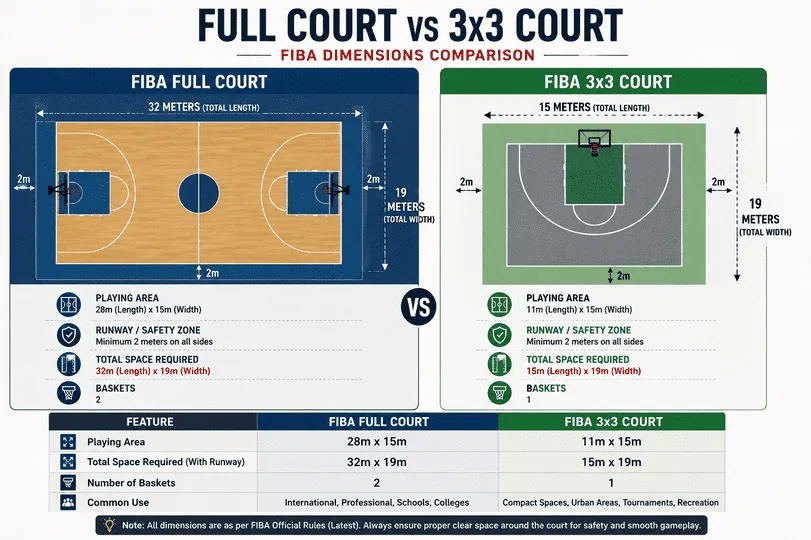
- Width: 15 meters
- Length: 11 meters
- Single basket
This format is widely used for:
- compact courts
- urban spaces
- commercial facilities
FIBA 3x3 Non-Playing Area
Similar to full courts, FIBA recommends:
- Minimum 2 meters of clear space on all sides
Total Space Required for 3x3
- Length: 11m + 2m + 2m = 15 meters
- Width: 15m + 2m + 2m = 19 meters
So, the minimum total area required is:
15m × 19m
Importance of Runway in Basketball
The runway is not extra space.
It is a core part of basketball court design.
Basketball is a fast-moving sport where players:
- sprint at high speed
- stop suddenly
- change direction frequently
Without proper runway:
- players are at risk of injury
- gameplay becomes restricted
- overall experience reduces
That is why runway should always be planned from the beginning.
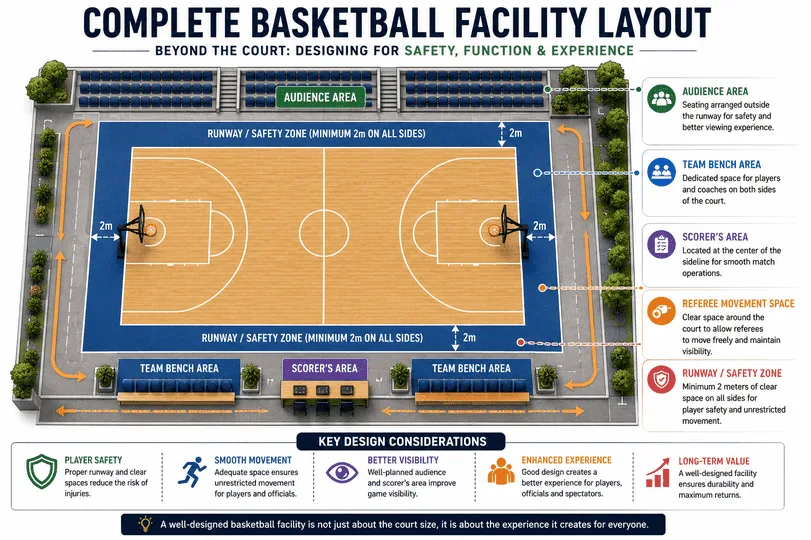
Designing Beyond the Court
A basketball facility is not just about the playing area.
Good design should also include:
Team Bench Area
Space for players and coaches, usually placed along the sideline.
Scorer’s Area
Positioned at the center of the sideline, used for match operations.
Referee Movement Space
Clear space around the court for officials to move safely and maintain visibility.
Audience Area
Seating or viewing space outside the runway, ensuring safety and good viewing experience.
Customization in Real Projects
In real-world projects, especially in cities like Tamil Nadu and Bangalore:
- land size varies
- budgets differ
- usage changes based on audience
Because of this, courts can be customized.
However, one principle should always guide the design:
Player experience comes first.
Even when dimensions are adjusted:
- gameplay should feel natural
- movement should not be restricted
- safety should not be compromised
Why Design Matters in Basketball Court Construction
Basketball is not just about dimensions.
It is about how the space is experienced.
A well-designed court ensures:
- better gameplay
- smooth movement
- higher safety
- long-term usability
Even with the right flooring, poor design will affect performance.
Final Thought
A basketball court is not just a marked surface.
It is a complete playing environment.
Following FIBA standards and planning the space properly will result in:
- better performance
- safer gameplay
- improved user experience
What’s Next
In upcoming blogs, we will cover:
- basketball court flooring systems
- cost of building a basketball court
- indoor vs outdoor court design
Follow us for more real insights from the sports infrastructure industry.