
Infrastructure · 6 min read · By Vignesh Manikandan
Published
FIFA World Cup 2026 Infrastructure and Flooring: How Natural Grass Systems Transformed 16 Stadiums Without Building a Single New Venue
Discover how FIFA World Cup 2026 transformed 16 existing stadiums using advanced natural grass systems, hybrid turf technology, and world-class sports surface engineering without building a single new venue.
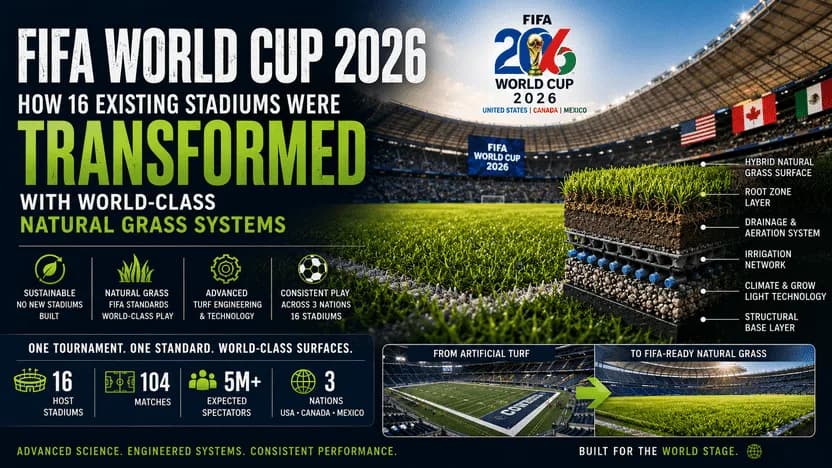
In short: FIFA World Cup 2026 is played in 16 existing stadiums in the USA, Canada and Mexico; no new stadium was built for it. Instead, the venues were prepared with natural and hybrid grass pitch systems, engineered root zones, drainage, irrigation and climate monitoring, which shows that the playing surface matters as much as the stadium.
FIFA World Cup 2026 Infrastructure: How 16 Existing Stadiums Were Transformed with World Class Natural Grass Systems
FIFA World Cup 2026: The Most Sustainable World Cup Ever Built
The FIFA World Cup 2026 will be remembered for several historic milestones.
- First World Cup featuring 48 teams
- First World Cup hosted by three countries
- 104 matches across North America
- 16 host stadiums
- More than 5 million expected spectators
But perhaps the most remarkable achievement is this:
Not a single new stadium was built specifically for the tournament.
Unlike many previous World Cups that required billions of dollars in new stadium construction, FIFA 2026 relies entirely on existing venues across the United States, Canada, and Mexico.
Instead of building new infrastructure, organizers focused on upgrading existing stadiums to meet FIFA's world-class football standards.
For sports infrastructure professionals, the real story lies beneath the players' feet.
The FIFA World Cup 2026 represents one of the largest sports surface engineering and turf infrastructure projects ever undertaken.
The Biggest Challenge: Football Cannot Be Played on NFL Turf
Many of the selected venues are primarily NFL stadiums.
Several of these stadiums normally operate with synthetic turf systems designed for American football, concerts, and entertainment events.
However, FIFA requires World Cup matches to be played on predominantly natural grass surfaces that deliver consistent playing characteristics across all venues.
This created a major engineering challenge.
Host venues such as:
- AT&T Stadium
- MetLife Stadium
- SoFi Stadium
- Mercedes-Benz Stadium
- NRG Stadium
- Lumen Field
- BC Place
- Gillette Stadium
required extensive surface modifications before hosting World Cup matches.
The objective was simple:
A football should roll, bounce, and react the same way in New York, Dallas, Toronto, Mexico City, and Vancouver.
Achieving this level of consistency required years of research, testing, and infrastructure upgrades.
Why FIFA Prefers Natural Grass
At the elite level, the quality of the playing surface directly affects:
- Ball roll speed
- Ball bounce consistency
- Player traction
- Injury prevention
- Match quality
Artificial turf behaves differently from natural grass.
Professional footballers have long argued that artificial surfaces can alter ball movement and increase physical stress on players.
To ensure fairness and consistency throughout the tournament, FIFA mandated natural-grass-based playing systems across all host venues.

Eight Years of Turf Research
Preparation for FIFA World Cup 2026 did not begin recently.
Research started nearly eight years before kickoff.
Experts from leading universities, including the University of Tennessee and Michigan State University, worked alongside FIFA turf specialists to develop a standardized grass system capable of performing across dramatically different climates and stadium environments.
The challenge was extraordinary.
The system had to perform successfully in:
- Hot and humid Houston
- High-altitude Mexico City
- Rain-prone Seattle
- Indoor stadiums such as Atlanta and Dallas
- Cooler regions like Toronto and Vancouver
The result was a highly engineered hybrid natural grass system capable of delivering consistent performance across North America.
Hybrid Grass: The Future of Elite Football Surfaces
Many people assume the World Cup uses pure natural grass.
In reality, modern FIFA tournament surfaces use advanced hybrid systems.
Approximately 95% of the playing surface consists of natural grass, reinforced with a small percentage of synthetic fibers integrated into the root zone.
This combination provides several benefits:
- Increased durability
- Better root stability
- Reduced surface deformation
- Consistent ball performance
- Improved player traction
Hybrid technology combines the playing characteristics of natural grass with the durability advantages of synthetic reinforcement.
For elite football competitions, this has become the preferred solution.
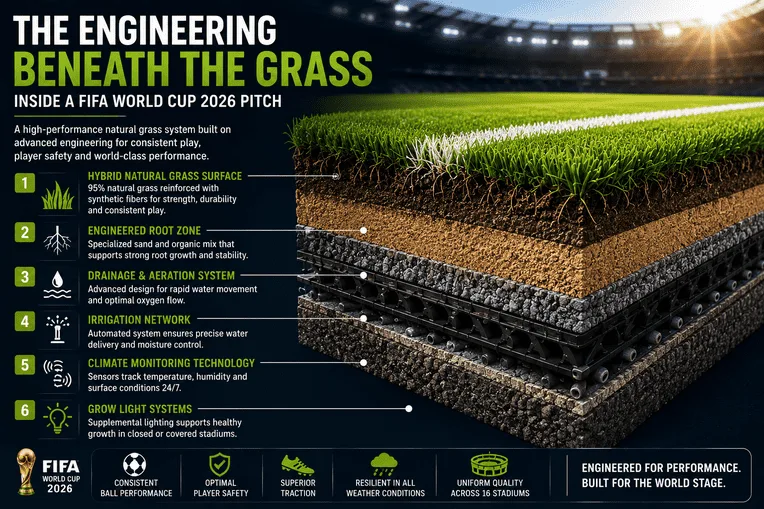
The Engineering Beneath the Grass
The visible turf is only the top layer.
Underneath lies a sophisticated sports flooring and turf engineering system.
A typical FIFA World Cup pitch includes:
1. Hybrid Natural Grass Surface
The visible playing layer used by athletes.
2. Engineered Root Zone
A specialized blend of sand and organic materials that supports root growth and stability.
3. Drainage and Aeration System
Designed to move water rapidly during heavy rainfall while maintaining surface quality.
4. Irrigation Network
Automated watering systems that help maintain optimal moisture levels.
5. Climate Monitoring Technology
Continuous monitoring of temperature, humidity, and surface conditions.
6. Grow Light Systems
Artificial lighting systems used in enclosed or partially covered stadiums where natural sunlight is limited.
Together, these technologies create one of the most advanced sports surfaces ever installed for a football tournament.
Different Grass for Different Climates
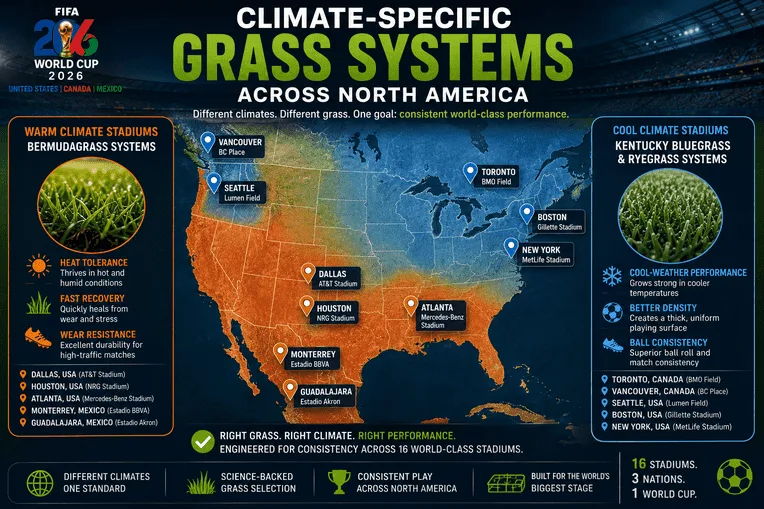
One grass species cannot perform optimally across North America's diverse climates.
As a result, FIFA adopted climate-specific turf strategies.
Warm Climate Stadiums
Cities such as:
- Dallas
- Houston
- Atlanta
- Monterrey
- Guadalajara
primarily utilize Bermudagrass-based systems.
Advantages
- Excellent heat resistance
- Strong wear tolerance
- Rapid recovery
- Deep root systems
Cool Climate Stadiums
Cities such as:
- Toronto
- Vancouver
- Seattle
- Boston
- New York
typically use Kentucky Bluegrass and Perennial Ryegrass blends.
Advantages
- Superior ball roll consistency
- High turf density
- Better traction
- Strong cool-weather performance
This regional approach ensures optimal playing conditions regardless of location.
Converting Artificial Turf Stadiums into FIFA-Ready Venues
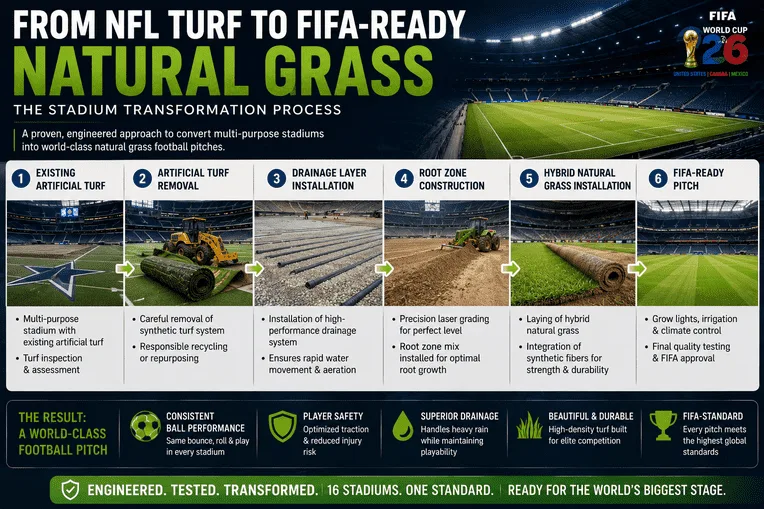
One of the most impressive aspects of FIFA World Cup 2026 is the turf conversion process.
Several venues temporarily removed or covered their artificial surfaces.
Engineers then installed:
- Drainage layers
- Sand profiles
- Root-zone systems
- Hybrid natural grass surfaces
In some stadiums, natural grass was installed over existing artificial turf using specialized shallow-profile systems.
Others removed synthetic fields entirely and rebuilt the surface from the base layer upward.
The process required:
- Precision engineering
- Specialized transportation
- Surface performance testing
- Ongoing monitoring and maintenance
Every pitch underwent extensive validation before tournament use.
Stadium Infrastructure Beyond the Playing Surface
While the turf receives most of the attention, FIFA's upgrades extended far beyond the pitch.
Host venues also improved:
- Player facilities
- Broadcast infrastructure
- Security systems
- Spectator circulation
- Accessibility features
- Digital connectivity
- Transportation integration
Many stadiums already possessed world-class infrastructure due to their NFL, MLS, and international event experience.
The focus was on adapting them specifically for football while improving the overall tournament experience.
What Sports Infrastructure Companies Can Learn from FIFA 2026
The biggest lesson from FIFA World Cup 2026 is not about building more stadiums.
It is about maximizing existing assets.
Rather than spending billions on new construction, organizers focused on:
- Surface engineering
- Venue modernization
- Sustainability
- Scientific maintenance
- Long-term usability
This approach demonstrates how existing sports facilities can be upgraded to international standards through better design, sports flooring systems, and maintenance practices.
For emerging sports markets like India, the lesson is clear:
The future of sports infrastructure lies not only in constructing new facilities but in improving the performance, durability, and sustainability of the facilities already available.
What this means for turf owners in India
Most turfs in India are artificial, not natural grass, but the same lessons apply: the base, the drainage and the right surface for the climate decide how a pitch plays and how long it lasts. See how we build football turfs and the artificial turf systems we install.
Conclusion
The FIFA World Cup 2026 is far more than a football tournament.
It is one of the largest sports infrastructure and sports flooring projects ever undertaken.
With zero new stadiums built specifically for the event, FIFA has demonstrated that sustainability and world-class performance can coexist.
From hybrid grass technology and advanced drainage systems to climate-controlled turf management and stadium modernization, the tournament establishes a new benchmark for sports facility development worldwide.
As athletes compete for football's greatest prize, one of the most important victories has already been achieved:
Proving that intelligent infrastructure upgrades can outperform large-scale construction.
For sports infrastructure professionals, the real star of FIFA World Cup 2026 may not be inside the stadium it may be the engineering beneath the pitch.