
Our Story · 8 min read · By Vignesh Manikandan
Published
India's Growing Sports Infrastructure — Are We Building Facilities or Developing Sports?
India’s sports infrastructure is growing, but are we doing enough to develop sports? From an athlete’s perspective, explore why building facilities is only the beginning, and how community participation, quality infrastructure, and grassroots development can shape the future of Indian sports.
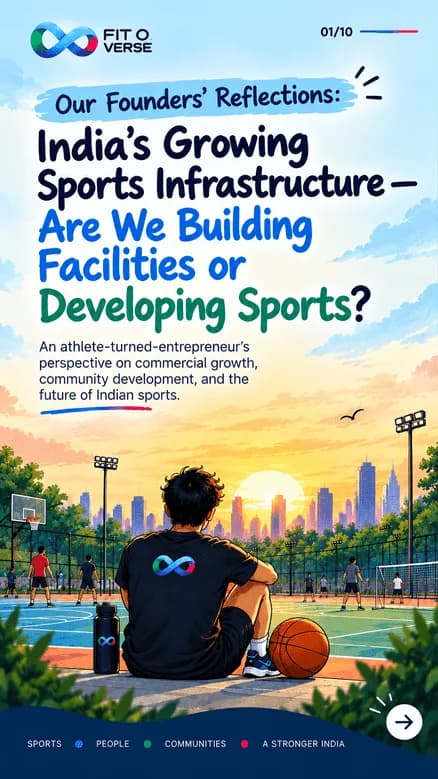
In short: India is building more sports facilities than ever, but a facility alone does not develop sport. In this article, Fitoverse founder Vignesh Manikandan looks at how usage, coaching and community decide whether a new court or turf actually produces players.
Where It All Started
When we started Fitoverse, we didn't really know much about the business side of the sports industry.
But we had one thing in common. We understood what it felt like to be an athlete in India.
Having gone through that journey myself, I had seen the difficulties athletes face. Not having access to the right facilities, proper coaching, financial support, and sometimes even the encouragement to pursue sports.
For many parents, sports was something that could affect their child's academics. The question was often about the outcome.
Will my child become a professional athlete? Is there a career in sports? What is the return?
These are genuine concerns.
But the reality is that not everyone who plays a sport will become a professional athlete. That is true not just in India, but across the world.
Somewhere along the way, I feel we have overlooked what sports gives us beyond becoming a professional athlete.
The character it builds, the friendships, discipline, mental and physical health, and the experiences that stay with us throughout life.
And this is not only about parents. Coaches, schools, athletes, and everyone involved have their own challenges.
The entire ecosystem plays a role.
Looking at Sports From the Other Side
When I entered the sports infrastructure business, I started seeing the industry from a different perspective.
I met people who had been building sports facilities for decades. Many had built successful businesses without necessarily coming from an athletic background.
And that is completely fine.
But I also felt that someone who has been an athlete brings another perspective. Having experienced these spaces as a player, you naturally start asking questions about the people who will eventually use them.
Over the years, I have seen sports infrastructure grow across cities, including Tier 2 and Tier 3 markets.
More football turfs, badminton courts, pickleball courts, padel courts, and commercial sports facilities are coming up.
This growth is encouraging. It creates opportunities for entrepreneurs, investors, facility owners, and the larger sports industry.
But one question has stayed with me.
Are we only increasing the number of places to play, or are we also improving the experience and opportunities for the people who play?
Because I feel there is a difference between commercial growth and the actual development of sports.
And both are equally important.
A Sports Facility Is More Than Just a Playing Surface
One thing I have come to understand is how important a sports facility is to the entire ecosystem.
Think about a small sports facility in a neighbourhood.
A child comes to learn football. A group of friends comes to play badminton. Adults come after work to stay active. A former athlete finds an opportunity to coach.
From that one space, many things begin.
Coaching, tournaments, sports equipment, apparel, nutrition, travel, and many other businesses connected to sports.
But beyond the business, something else happens.
People build friendships. Children learn discipline. Adults find a reason to stay active. Athletes find people who understand their struggles.
A facility can become a place where people feel they belong.
Not everyone who enters that space needs to compete or become a professional athlete.
Some might simply want to play.
That, to me, is also sports development.
If we can create more accessible and well-managed community spaces, I believe the long-term impact can go beyond sports itself.
It can contribute to healthier people, stronger communities, and a generation that sees physical activity as part of everyday life.
And when we think about sports infrastructure this way, we are not just thinking about building courts. We are thinking about creating opportunities for people to live healthier and more active lives.
Where Do Money, Sustainability and Impact Meet?
Having been on the business side, I understand that sports facilities need to make money.
Investors need returns. Facility owners need sustainable revenue. Companies need profits to survive, grow, and innovate.
There is nothing wrong with that.
In fact, without commercial sustainability, many of these ideas cannot continue for long.
We are also seeing new sporting formats and fitness trends gaining popularity. HYROX, pickleball, padel, and other activities are bringing new people into sports and fitness.
That is encouraging.
But I sometimes wonder what happens beyond the trend.
Are we creating something that people will continue to engage with? Are we developing sporting habits? Are we creating opportunities for coaches, athletes, and communities?
Or are we simply following the next commercially successful category?
I don't think commercial success and social impact need to be two different things.
A good sports business should be able to make money, sustain itself, and create meaningful value for the people around it.
For me, that balance matters.
And I believe there is an opportunity for investors and entrepreneurs to build businesses where financial returns and the long-term growth of sports coexist.
A commercially successful facility can also support coaching programmes, local tournaments, community participation, and opportunities for former athletes.
The question is how we design the business so that these things grow together.
Research, Innovation and Our Own Capabilities
Another pattern I have noticed is how dependent our sports infrastructure industry is on products and technologies developed elsewhere.
There are excellent international products, and they have helped our industry grow.
But I keep wondering why we cannot also develop more of our own solutions.
We have good engineers, researchers, institutions, and manufacturing capabilities in India.
What if we bring more research and development into sports infrastructure?
What if we design flooring, facilities, and products specifically for our weather, playing conditions, communities, and affordability?
What if we can make good-quality sports infrastructure accessible to more people, not just those who can afford premium facilities?
I am not saying everything needs to be manufactured in India or that imported products are a problem.
But I believe having stronger research, testing, design, and manufacturing capabilities can help us innovate and create solutions suited to our needs.
And innovation does not always have to mean something big.
Sometimes a small improvement in safety, a more affordable playing surface, or a better-designed community court can make a meaningful difference.
These are opportunities I believe we should explore more deeply.
The People Who Can Make These Spaces Better
I also see a huge opportunity for former athletes, coaches, and sports management professionals.
We often associate sports management with large tournaments, international competitions, and major sporting events.
But what about the thousands of smaller facilities across the country?
Who is helping facility owners understand the people using their spaces?
Who is thinking about coaching programmes, local tournaments, community engagement, player development, and the overall experience?
I feel people who have experienced sports firsthand can contribute a lot here.
If these spaces are managed well, they can also create sustainable livelihoods for coaches, former athletes, and many others connected to sports.
That is another form of impact we should be thinking about.
And this is where I see a connection between infrastructure development and the larger sports economy.
A facility can create demand for coaching. Coaching can bring more children into sports. More participation can support tournaments, sports businesses, and new opportunities.
But this does not happen automatically just because a court is built.
It needs people who understand sports, good management, and a willingness to think beyond construction.
Building for the Future
We often talk about India becoming a sporting nation, winning more Olympic medals, hosting international competitions, and building world-class stadiums.
All of these are important ambitions.
But I feel we should also be asking what happens at the grassroots.
What happens in the small court where a child first learns to play?
What happens in the community facility where adults come every evening?
What happens to the former athlete who wants to continue contributing to sports through coaching?
Elite sporting success requires years of training, exposure, nutrition, psychology, technology, and support.
At the same time, building a healthier sporting nation requires opportunities for people to play throughout their lives.
These are different goals, but I believe we can work towards both.
And sports infrastructure can be one of the starting points.
Of course, this needs more than companies building facilities.
It requires collaboration between governments, investors, researchers, educational institutions, coaches, and communities.
It also requires us to think carefully about how policies, funding, and opportunities reach the people who can create meaningful change.
I believe there is an opportunity to make sports development more accessible, transparent, and connected to the needs of the people who actually use these spaces.
A Thought I Want to Carry Forward
As someone building a company in this industry, I understand that we have our own challenges.
We need to generate revenue, sustain our operations, grow our business, and compete in the market.
And I am still learning how to balance all of this.
But I don't want to lose sight of why we entered this industry in the first place.
I want the athletes who use the facilities we build to feel a difference in safety, quality, and experience.
I want people to have spaces where they can play, connect, and belong.
I want to see coaches and former athletes finding sustainable opportunities within sports.
And I want us to keep asking how research, innovation, and better infrastructure can make sports accessible to more communities.
I don't think any single company can change the entire ecosystem.
But I believe each of us can contribute in our own way.
These are not conclusions I have arrived at. They are thoughts that have developed through my journey as an athlete and now as an entrepreneur.
I am sharing them because I believe these conversations are worth having with fellow entrepreneurs, investors, athletes, researchers, and everyone working towards the future of Indian sports.
Maybe the question is not just how many sports facilities we build, how much revenue we generate, or how many medals we win.
Maybe we should also ask how many lives we are improving through sports.
And if we can build businesses that are commercially successful while making that difference, I believe we are moving in the right direction.
Vignesh Manikandan
Founder, Fitoverse