
Sports · 4 min read · By Vignesh Manikandan
Published
Football & Cricket Turf Size Guide: Commercial Dimensions in Tamil Nadu & Bangalore
Planning to build a sports turf in Tamil Nadu or Bangalore? Discover the sweet spot for turf dimensions that balance your investment costs with maximum revenue. From 5-a-side layouts to high performance cricket football hybrid designs, we break down how to build a facility that keeps players coming back.
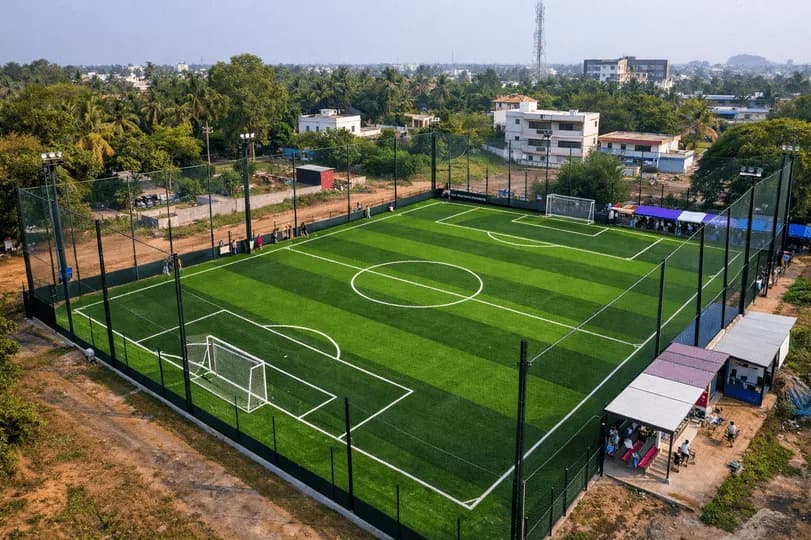
In short: Most commercial turfs in Tamil Nadu and Bangalore are 5,000–8,000 sq ft for 5-a-side football, or 7,000–14,000 sq ft for 5- and 7-a-side football and academy training. Many are 2-in-1 turfs with a cricket pitch strip inside the football area.
| Format | Typical turf size | Pitch size (approx.) |
|---|---|---|
| 5-a-side football | 5,000–8,000 sq ft | 25 × 16 m to 35 × 22 m |
| 5- and 7-a-side football | 7,000–14,000 sq ft | 40 × 25 m to 60 × 40 m (7-a-side) |
| 11-a-side football | Full field | 90–120 × 45–90 m |
Sports Turf Dimensions Guide: Common Sizes Used in Commercial Sports Arenas (Tamil Nadu & Bangalore)
Introduction
When planning to build a sports turf for commercial use, one of the first and most important decisions is choosing the right size and layout.
The dimensions of a sports turf depend on:
- land availability
- budget
- target users
- sport focus (football, cricket, multi-sport)
From our experience working on projects across Tamil Nadu and Bangalore, we see clear patterns in how most commercial turfs are designed.
Typical Turf Sizes in Tier 2 and Tier 3 Cities
Most commercial turfs in Tier 2 and Tier 3 cities are built by landowners looking to generate additional income.
Because of this, the focus is usually on:
- optimal land usage
- controlled investment
- maximum playability
5000 to 8000 Sq Ft
This is the most common range.
These turfs are usually:
- compact
- budget-friendly
- easy to maintain
They are widely used for:
- 5 vs 5 football
- casual games
- community-level play
This size works well for first-time turf owners.
Medium to Large Commercial Turf Sizes
For owners who want a more structured sports facility, especially for football:
7000 to 14000 Sq Ft
These turfs are designed for:
- better gameplay
- larger groups
- more structured usage
They are commonly used for:
- 5 vs 5 and 7 vs 7 football
- academy training
- commercial bookings
This range offers a balance between investment and long-term returns.
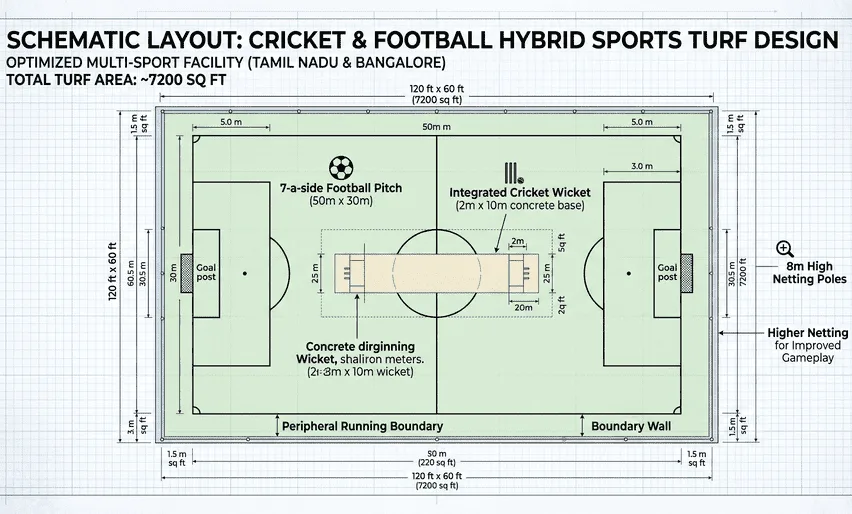
Cricket + Football Hybrid Turf Design (2-in-1 Model)
One of the most preferred designs today is a hybrid turf combining cricket and football.
This is widely used across Tamil Nadu and Bangalore.
Cricket Pitch Integration
In this model:
- a cricket pitch of approximately 2m x 10m is created within the turf
- the pitch uses a concrete base
This is done to ensure:
- consistent bounce
- better cricket experience
The remaining area is used as football turf, making it a multi-sport facility.
Why This Design Works
- supports both cricket and football
- increases booking opportunities
- improves overall ROI
Importance of Turf Height and Net Design
Another major design change we see today is the increase in height of fabrication poles and netting.
Earlier, many turfs had lower net heights, which created problems:
- balls hitting the net frequently
- limited gameplay
- poor cricket experience
Now, most turfs are designed with higher structures.
Why Height Matters
- improves cricket gameplay
- reduces interruptions
- enhances user experience
- supports better football play
Especially for cricket, higher net height makes a big difference.
Official Football Dimensions (Standard Reference)
While commercial turfs are customised, it is important to understand standard football dimensions.
5 vs 5 Football
- Approx: 25m x 16m to 35m x 22m
- Common in 5000–7000 sq ft turfs
7 vs 7 Football
- Approx: 40m x 25m to 60m x 40m
- Used in medium-sized turfs
11 vs 11 Football
- Length: 90m to 120m
- Width: 45m to 90m
These are full-size fields and are rarely used in urban commercial projects due to space constraints.
Flexibility in Turf Design: Customisation with Player Experience in Mind
One important thing to understand is that sports turf dimensions and shapes can be customised.
Most commercial turfs are built based on:
- available land
- budget
- target users
Because of this, the shape of the turf does not always have to follow strict rectangular dimensions.
Custom layouts are possible.
However, one principle should always guide the design:
Playability should always come first.
The design should be based on how players experience the game, not just how the space fits into the land.
Even when dimensions are adjusted, the goal should be to:
- maintain natural gameplay
- support player movement
- align with the rules of the sport
The standard dimensions mentioned earlier are important because they are designed to:
- match real playing conditions
- support the flow of the game
- create a balanced experience
In commercial projects, business considerations are important.
But even then:
User experience comes first.
And within that, player experience matters the most.
A well-designed turf always focuses on how the game is actually played.
Choosing the Right Turf Size
There is no single perfect size.
The right dimension depends on:
- your land size
- your investment plan
- your target users
- your sport focus
But based on current trends:
- 5000–8000 sq ft → best for entry-level turfs
- 7000–14000 sq ft → best for football-focused facilities
- hybrid designs → best for maximizing usage and revenue
Final Thought
The success of a sports turf is not just about construction.
It depends on how well the dimensions, layout, and user experience are planned.
Choosing the right design directly impacts:
- gameplay
- customer satisfaction
- long-term returns
What’s Next
In upcoming blogs, we will cover:
- cost of building a turf
- ROI of commercial sports turfs
- how to choose the right turf system
Follow us for more real insights from the sports infrastructure industry.